
- 1. Foundation of Signals: Electromagnetic Waves and Spectrum
- 2. Protocol Evolution: From 802.11 to Wi-Fi 7
- 3. Signal Generation, Propagation and Attenuation
- 4. Reception, Interference and Optimization
- 5. Security Architecture
- 6. Deployment, Applications and Performance Optimization
- 7. Common Issues and Practical Tips
- 8. Health, Regulations and Future Trends
WLAN is shortage name of Wireless Local Area Network, WLAN signal is invisible arterie of modern digital life. Far more than just wireless internet, WLAN signal is complex communication system based on radio frequency (RF) technology, integrate radio physics, computer networking protocols and information security mechanisms. Whether you stream video at home, work in café or controll smart home devices, WLAN signal carry vast quantity of data silently through the space around you. Understand their nature will help you to use them more effectively and troubleshoot connection issues efficiently.
1. Foundation of Signals: Electromagnetic Waves and Spectrum
Physical carrier of any WLAN signal is electromagnetic wave, specifically radio waves within particular frequency bands. Belong to the same family as visible light and broadcast radio, WLAN waves operate in two license-free Industrial, Scientific and Medical (ISM) bands:
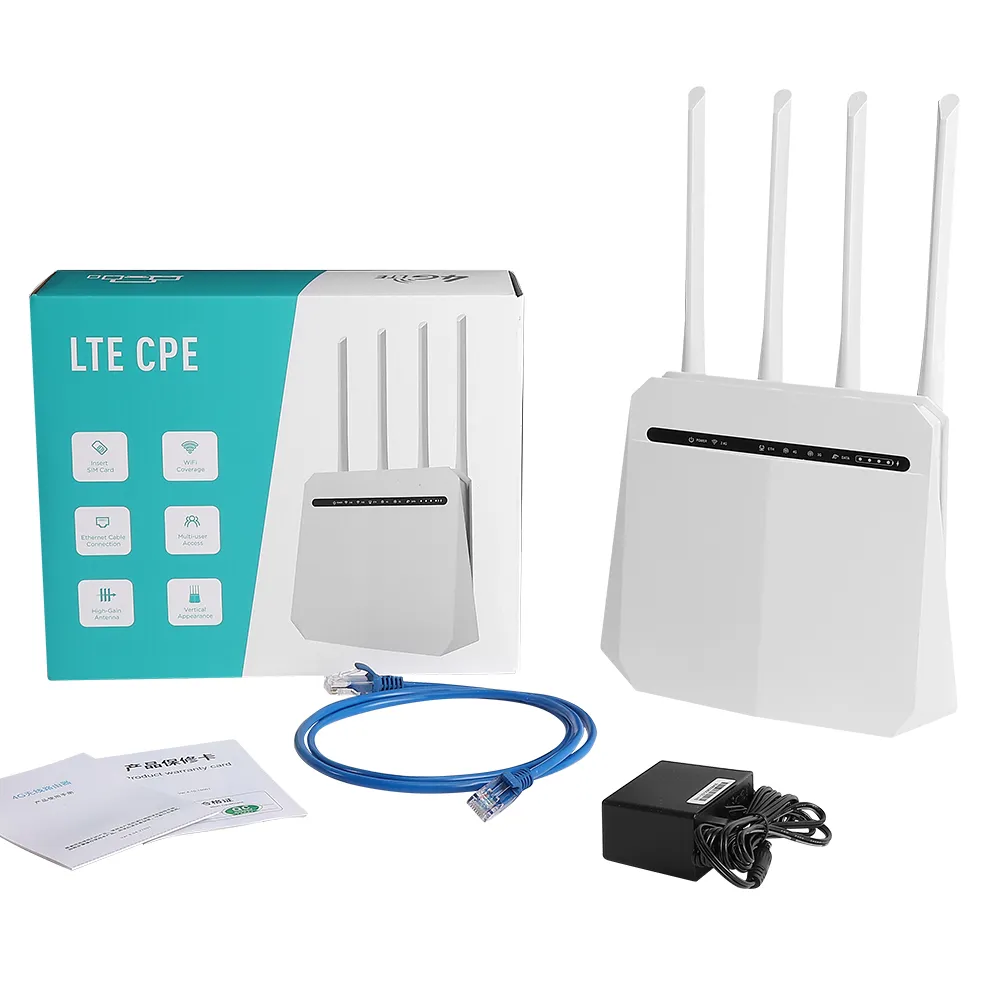
2.4GHz Band (2400–2483.5MHz): Waves with longer wavelength, provide better diffraction (ability to bend around obstacles) and penetration through walls, result in wider coverage. However, this band is crowded and susceptible to interference from microwave ovens, Bluetooth devices, cordless phones and neighboring cpe 4g lte router or wifi router 5g sim.
5GHz Band (5725–5850MHz): Shorter wavelengths mean poorer penetration but less interference, this band offers many more non-overlapping channels, provide more stable and high-speed connections over shorter distances.
In China, the Ministry of Industry and Information Technology (MIIT) has designated these bands for WLAN use. 2.4GHz band has 13 overlapping 20 MHz channels, while 5GHz band provides numerous non-overlapping channels. Think of it as a multi-lane information highway: 2.4GHz and 5GHz are two main roadways, each subdivided into “sub-channels” for different Access Points (APs, commonly called routers) to use, minimize mutual interference.
2. Protocol Evolution: From 802.11 to Wi-Fi 7
WLAN signals must follow strict traffic rules, which defined by IEEE 802.11 family of protocols, evolution of this standard charts the relentless progress of WLAN speed and capability:
Early Standards: Original 802.11 (1997) supported only 2Mbps, 802.11b (2.4GHz) and 802.11a (5GHz) brought initial popularity.
Major Leap: 802.11n(Wi-Fi 4) introduced MIMO (Multiple-Input Multiple-Output) technology, use multiple antennas simultaneously to dramatically boost speed and range.
Current Mainstream: 802.11ac (Wi-Fi 5) primarily uses 5GHz band. With wider channels (up to 160 MHz), advanced modulation (256-QAM) and more spatial streams, it achieves gigabit theoretical speeds (up to 1.3Gbps, later enhanced to 3.5Gbps).
Latest Generation: 802.11ax (Wi-Fi 6) optimizes efficiency in high-density environments. It uses OFDMA (Orthogonal Frequency-Division Multiple Access) to divide channels into smaller Resource Units (RUs), allow many more devices to communicate simultaneously. It increases concurrent connections per AP fourfold, reach theoretical speeds of 9.6 Gbps, this is ideal for homes with many smart devices or crowded public spaces.
Future Trend: Upcoming 802.11be (Wi-Fi 7) will introduce Multi-Link Operation (MLO), allow devices to transmit data across multiple bands at once. It promises sub-5 millisecond latency, single-device speeds exceed 20 Gbps, support for industrial IoT and 8K video streaming.
3. Signal Generation, Propagation and Attenuation
Generation and Modulation: Wireless network card in your cpe 4g lte router or wifi router 5g sim converts digital data (0s and 1s) into analog radio waves through a process called modulation. From basic BPSK to efficient 1024-QAM, higher modulation orders pack more bits per wave, enable faster speed but require cleaner and stronger signal.
Propagation and Attenuation: Once transmitted, signals propagate through space. 2.4GHz signals diffract better for wider coverage; 5GHz signals offer less interference but weaker penetration. Signals inevitably attenuate (weaken) with distance. Walls, metal objects and even water in human body absorb or reflect signals, reduce signal strength. Professional deployments will avoid load-bearing walls and metal obstacles, use a cellular layout with 15-25% signal overlap between APs.
The Role of Antennas: Antennas are interpreters and amplifiers for signals. Omnidirectional antennas radiate uniformly in all directions, like a light bulb, suitable for general home coverage. Directional antennas focus energy in one direction, like a flashlight, ideal for long-distance point-to-point links. Enterprise APs often integrate multiple smart antennas, enable beamforming to focus signal energy toward specific clients, improve performance at the cell edge.
4. Reception, Interference and Optimization
Receiver Sensitivity: Your phone or laptop’s ability to receive signal depends on its wireless card’s receiver sensitivity (expressed in negative dBm; more negative number indicates better ability to detect weak signals). Professionally, signal strength should be above -67 dBm, with Signal-to-Noise Ratio (SNR) above 25dB and Bit Error Rate (BER) below 10⁶.
Sources of Interference: 2.4GHz band is particularly crowded. Microwave ovens, Bluetooth devices, cordless phones and neighboring cpe 4g lte router or wifi router 5g sim create co-channel interference—like multiple people shouting in a small room. 5GHz band has less interference but is not immune.
Channel and Bandwidth Selection: In 2.4GHz band, it is recommended to use only channels 1, 6 or 11 as they are non-overlapping channels. 5GHz band offers many more choices. Bandwidth is like lane width: 20MHz is a narrow lane, but 40, 80 or 160MHz are wide lanes. Wider bandwidths yield higher speed but are more susceptible to interference. In high-density scenarios, features like Spatial Division Multiple Access (SDMA) and dynamic power adjustment can increase overall system capacity by over three times.
5. Security Architecture
Open electromagnetic waves mean anyone can receive your data, so lock your signal is crucial. WLAN security protocols have evolved through four generations:
WEP (Wired Equivalent Privacy): Proven to be highly vulnerable.
WPA/WPA2 (Wi-Fi Protected Access): A major improvement, use strong AES encryption. WPA2 is the current baseline requirement.
WPA3 (Latest Standard): Uses 192-bit encryption strength and Simultaneous Authentication of Equals (SAE) to effectively defend against dictionary attacks. Even if the password is stolen, past communication data cannot be decrypted. The enterprise version supports EAP-TLS certificate authentication.
According to China’s Cybersecurity Law and Classified Protection 2.0 standard, public WLANs must deploy wireless intrusion detection systems (WIDS) and terminal authentication mechanisms, while maintaining access logs. Ensure your cpe 4g lte router or wifi router 5g sim enables WPA3 and uses a strong password is the first line of defense for network security.
6. Deployment, Applications and Performance Optimization
Professional Deployment Essentials: Deployments must follow standards such as YD/T 5164-2017, include site surveys (electromagnetic environment testing), coverage simulation and channel planning. For special environments like hospitals and airports, anti-interference measures for medical devices and high-density user access are required, often necessitate tri-band APs with load balancing.
Industry Applications:
Education: Supports 4K video streaming and AR/VR teaching in smart classrooms.
Healthcare: Enables real-time transmission of vital signs from wireless medical devices.
Retail: Uses Wi-Fi probe technology to analyze customer traffic flow.
Industrial IoT: Combines TSN (Time-Sensitive Networking) with WLAN to achieve microsecond-level synchronization accuracy for motion control systems, meet stringent demands of smart manufacturing.
Performance Optimization Strategies:
Use spectrum analyzer to detect co-channel interference and employ channel bonding to increase throughput.
Use beamforming to improve signal strength at the cell edge.
Use smart roaming protocols (802.11k/v/r) to ensure millisecond-level continuity as mobile clients switch between APs.
For large homes or multi-story buildings, Mesh network systems consisting of multiple nodes create a unified network, allow devices to seamlessly switch to the strongest signal and eliminate dead zones.
7. Common Issues and Practical Tips
Key Factors Affect Speed: Actual experienced speed is the result of signal strength, interference and channel width, the protocol standards supported by both AP and client (the weakest link), the number of simultaneously connected devices (bandwidth sharing) and the ISP’s provided internet bandwidth. A Wi-Fi 6 phone connect to Wi-Fi 4 router cannot achieve high speed.
Diagnostic Methods: Common faults can be diagnosed by checking signal strength (should be > -67 dBm), SNR (>25 dB) and BER (<10⁶). A spectrum analyzer can identify interferers like microwave ovens or Bluetooth devices. A protocol analyzer can capture abnormal frames with high retransmission rates. For roaming issues, check if 802.11k neighbor reports are enabled and if fast BSS transition is configured between APs.
Summary of Practical Optimization Tips:
1.Place your cpe 4g lte router or wifi router 5g sim in central location, but far away from microwave ovens, load-bearing walls and metal objects.
2.Select the least congested channel manually(better use 1, 6 or 11 for 2.4GHz).
3.Assign devices to different bands: connect high-speed devices to 5GHz, legacy or distant devices to 2.4GHz.
4.Update your router’s firmware regularly for security and performance.
5.For complex environments, consider to upgrade to Wi-Fi 6 router or deploy a Mesh system.
8. Health, Regulations and Future Trends
Health and Radiation: WLAN signals are a form of non-ionizing radiation, energy is far below that of visible light, can’t damage human cellular DNA. Studies by the World Health Organization (WHO) and other authoritative bodies show that at routine exposure levels, WLAN signals have no harmful health effects. Their transmission power is typically limited to 100 mW (2.4GHz) and 200 mW (5.8GHz), far lower than a mobile phone, and it drops sharply with distance.
Regulatory Compliance: According to China’s Radio Regulations, all WLAN equipment must obtain a type approval license. Public deployments must comply with the identity authentication and log retention requirements of the Cybersecurity Law. Exported products must meet EU RED Directive 2014/53/EU or US FCC Part 15 rules.
Integration with 5G: 3GPP Release 16 defines the architecture for 5G and WLAN convergence, enable dual-network concurrent transmission via ATSSS (Access Traffic Steering, Switching and Splitting) functionality. A terminal can connect to core network through both 5G base station and WLAN AP simultaneously, with the network intelligently distributing data flows. This improves reliability and offloads mobile data traffic.
Future Outlook: Latest WLAN (802.11be) Wifi 7 will introduce multi-link operation and millimeter-wave band (60GHz) applications. Integration of artificial intelligence (AI) will enable network self-optimization and fault prediction. Digital twin technology can validate deployment plans via virtual mapping. Future wireless signals will become increasingly intelligent, capable of sensing the environment and self-optimizing, provide invisible yet ubiquitous and ultra-reliable connectivity.
Conclusion
Wireless LAN signal is far more than an abstract concept. It is a precise, dynamic and constantly evolving technical system born from the intersection of physics, electronic engineering and computer science—the invisible bridge carrying our digital lives. From protocol standards to antenna angles, from channel selection to security encryption, every detail impacts your online experience. Deeply understanding these principles and putting them into practice, you can master this bridge better and enjoy a stable, fast and secure wireless world.


What can we do for you?