
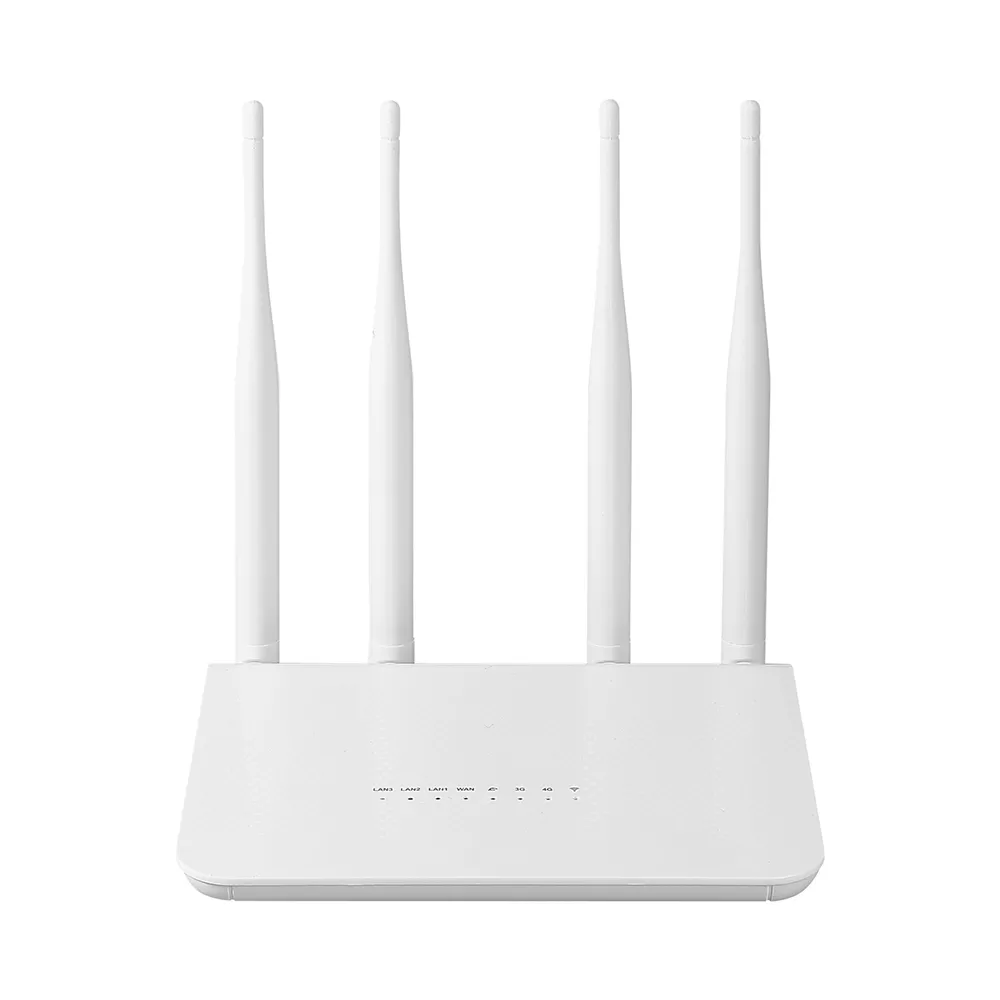
When you want to use router 4g lte CPE or indoor 5g CPE to build home or office network, we often pay attention to wireless transmission speed, capacity or cool appearance of the CPE, but it is easy to neglect a basic and key parameter-power. CPE power refers to electricity consumed when it is working, usually in watts, directly affects performance, coverage, heat generation and long-term use. Understanding the composition and significance of CPE power helps users to make more sensible trade-off between signal strength, stability and energy consumption when purchase and use it, thereby achieving efficient and economical home network deployment.
Basic definition and unit of power
From physical perspective, power refers to work done or energy consumed per unit of time. For electronic equipment such as CPE, its power refers specifically to the rate of power itself draws from the power supply under normal operating conditions, the standard unit of measurement is watts. A simple analogy is: If data is compared to water flow, then the CPE is water pump, and the power represents the amount of electricity needed to drive the water pump. Higher power usually means that core components such as chips and radio frequency modules inside the CPE can process more energy per unit of time, but this is not equivalent to faster network speeds.
Typical composition of CPE power
Total power consumption of a CPE is not a single value, but composed of multiple parts superimposed. The most important power-consuming unit is the main processor, which is responsible for routing calculations, packet forwarding and system scheduling; followed by wireless radio frequency module, especially for products that support multiple frequency bands (such as 2.4GHz and 5GHz) and equipped with multiple high-gain antennas. Its radio frequency power amplifier is a major power consumer, meanwhile memory, flash memory, various interfaces and indicators also consume a small amount of power, so the power consumption of high-end CPE with complex functions and powerful performance will often be higher than that of an entry-level product with simple functions.
Marked power and actual operating power
Power value marked on CPE’s power adapter or nameplate typically refers to maximum input power or rated power, it is a theoretical upper limit indicating the device’s potential power consumption under extreme load. For many home usage scenarios in reality, CPE’s actual operating power remains significantly lower than this nominal value. For example during nighttime with idle network activity, power consumption may drop to very low levels, while it increases when multiple users engage in high-definition video streaming, large-scale online gaming or file downloads simultaneously. Understanding this will help us more objectively assess the CPE’s energy consumption.
Relationship between power and wireless signal coverage
Coverage range and strength of wireless signals closely related to transmission power of CPE. According to the national radio management regulations, there is clear limit on wireless transmission power of household wireless CPE, for example 2.4GHz band usually does not exceed 100milliwatts, and manufacturers will design within the scope permitted by regulations. Higher compliant transmission power theoretically allows signals to travel farther and have slightly stronger wall penetration capabilities. However, it should be noted that the coverage effect is not only determined by transmission power, but also by factors such as antenna design, gain, chip scheme and environmental interference. Blindly pursuing high power does not always bring better experience.
Correlation between power and performance
There is complex balance between power and performance. More powerful processors and RF chips require sufficient power support to operate at full speed, thereby ensuring stability and low latency when high bandwidth and multiple devices are concurrent. On the other hand, excellent chip design and algorithm optimization can achieve outstanding performance at relatively low power consumption, which is reflection of energy efficiency ratio. So we cannot simply assume that ‘the higher the power, the better the performance’, should focus on energy efficiency and actual evaluation performance of specific chip platforms.
Impact of heat dissipation design on power
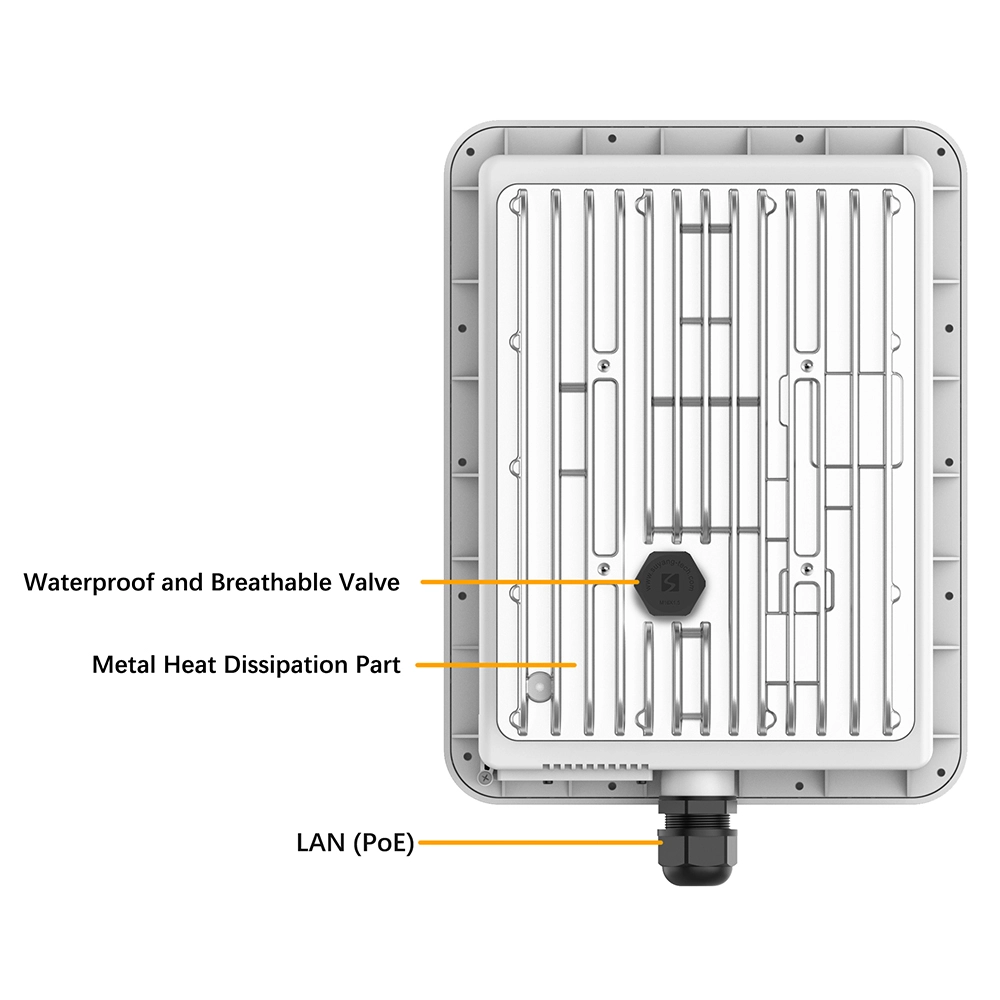
Power consumption inevitably generates heat, if heat accumulation inside CPE cannot be dissipated in time, it will cause chip temperature to be too high. To prevent damage, chip will activate a frequency down protection mechanism, which will directly lead to performance degradation and network instability. So good heat dissipation design (such as metal casing, heat dissipation fins, heat dissipation holes and even built-in fans) is crucial to maintain stable operation at high power levels, if you want to choose high-performance CPE, users should also pay attention to its cooling solution is reliable or not.
Energy efficiency rating and environmental considerations
With popularization of green environmental protection concepts, energy efficiency of electronic products has also won attention, some countries and regions have implemented energy efficiency standards for network equipment. For consumers, choosing energy-efficient CPE means consuming less electricity while providing same or better service. This not only reduces household electricity expenses, but also contributes to environmental protection in long run. When comparing parameters, you should pay attention to whether the router promotes relevant energy-saving technologies or certifications.
Power differences among CPE of different categories
There is a significant difference in power consumption among CPE products in the market. Traditional single band, single antenna home CPE may only consume around 3Watts of power. Currently, mainstream dual band gigabit CPE typically consume between 4Watts and 8Watts of power. As for high-end tri band 10 Gigabit CPE, gaming CPE, or enterprise level CPE, their power consumption ranges from tens of watts to thirty watts due to the integration of more powerful multi-core processors, multiple RF chips, and rich interfaces and functions. When making a purchase, it is necessary to balance performance and power consumption based on one’s own network requirements.
The importance of power adapters
The quality of power adapter that provides power to the CPE is directly related to the stability and safety of power transmission. A high-quality adapter can provide stable and pure DC power, and has overvoltage and overcurrent protection functions. However, low-quality adapters not only have low conversion efficiency (high power consumption), but their output may also be unstable, which can easily lead to abnormal CPE operation, restarts, and even damage. Be sure to use genuine or properly matched branded power adapters.
Practical tips for reducing CPE power consumption
Users can optimize power consumption of the CPE through some settings. For example, when network is not in use (such as late at night), the CPE’s scheduled restart or scheduled shutdown of wireless functionality can be enabled. If there are not many connected devices at home, you can consider to turn off unnecessary frequency bands. Ensuring that CPE is placed in a well ventilated area away from heat sources can also prevent efficiency reduction and power consumption caused by overheating. Regularly updating firmware and sometimes obtaining energy efficiency optimizations provided by manufacturers.
Potential correlation between power and equipment lifespan
Long time operation under high temperature and high load conditions will accelerate the aging of electronic components inside the CPE, especially electrolytic capacitors and other components, which may shorten the stable service life of the equipment. Keeping CPE operating at suitable temperature and loads can help to extend their service life, this is also why good heat dissipation and avoiding continuous full load operation are repeatedly emphasized.
Future technological development trends
With advancement of chip manufacturing processes and design optimization, energy efficiency ratio of CPE is constantly improving. For example, using processors with more advanced nano processes can reduce power consumption while improving performance. New wireless standards are also pursuing higher spectrum efficiency and energy efficiency, in addition, intelligent power management functions will become more popular, CPE can adjust working status and power of each module in real-time and dynamically based on network traffic, achieving refined energy-saving control.
Suggestions for comprehensive evaluation when to purchase
When making final decision, power should be considered as a comprehensive factor rather than the sole indicator. Firstly make clear your core needs: how much coverage area, how many device connections and what network applications. Then in the product pool that meets performance requirements, their power consumption levels, heat dissipation designs and energy efficiency characteristics can be compared. Referring to actual test data from authoritative evaluation agencies or professional media will be more valuable than simply looking at the factory’s nominal parameters.
Common Misconceptions and Clarifications
There are several common misconceptions about CPE power that need to be clarified. First power is not equal to signal strength, both antenna and algorithm are same critical. Second, lower power does not necessarily mean better as low power may not be able to support stable operation of multiple devices. Third, power consumption during shutdown or standby should also be taken into account, as some CPE still consume a significant amount of electricity when in standby mode. Fourth, do not attempt to “flash” or modify transmission power by yourself as this is illegal and may damage the CPE and pose radiation safety hazards.
Summary and Core Cognition
In summary, CPE power is a comprehensive technical parameter that connects multiple dimensions such as performance, coverage, stability, heat dissipation, energy consumption and cost etc. As users needn’t to delve into all the technical details, but it is crucial to establish a basic cognitive framework: understanding its composition and influencing factors, learning to weigh the pros and cons in specific usage scenarios, and optimizing energy efficiency through reasonable settings and maintenance. In today’s rapidly developing technology, choosing a CPE that strikes a delicate balance between performance and power consumption is the key to provide powerful and cost-effective network foundation for our digital lives.


What can we do for you?