
A single hour of network downtime costs mid-sized enterprises an average of $300,000 in lost revenue and operational paralysis. When overseas procurement officers and network architects search for the best lte 5g router, they aren’t looking for a flashy consumer gadget to browse social media at home. They are searching for an enterprise-grade gateway capable of handling data-dense environments, securing cross-border communications, and ensuring that global supply chains never freeze due to a dropped connection.
Achieving this level of industrial resilience requires moving away from standalone single-mode devices. The modern commercial frontier demands a converged hybrid infrastructure that seamlessly bridges existing legacy LTE networks with the ultra-low latency of Standalone (SA) 5G.
Bridging the Spectrum Gap: The Logic of Hybrid Network Convergence
Many commercial buyers mistakenly evaluate cellular hardware based solely on peak theoretical speeds. However, real-world deployment across international markets—from remote logistics hubs in Australia to manufacturing plants in Mexico—presents a chaotic mix of carrier frequencies and infrastructure readiness.
The value of a top-tier hybrid router lies in its spatial multiplexing capabilities. By utilizing advanced 4×4 MIMO antenna arrays, the hardware simultaneously samples multiple signals across different frequency bands. If a local carrier’s 5G network experiences congestion or atmospheric attenuation, the router does not drop the session. Instead, it utilizes intelligent carrier aggregation, instantly shifting packet streams to available high-category LTE channels (such as Cat 6 or Cat 12).
This dynamic handover happens at the firmware layer within milliseconds. To the end-user or the automated assembly line, the network appears as a single, unbreakable pipe of data. For B2B businesses managing hundreds of automated teller machines (ATMs), smart warehouses, or remote security perimeters, this cellular synergy translates directly into eliminated field-service costs and protected operational margins.
Network Slicing and Protocol Security at the Edge
A true business-critical gateway must do more than route traffic; it must protect the integrity of the data it carries. As enterprises migrate their operations to cloud-based ERP systems and real-time telemetry, the best lte 5g router must act as a hardened firewall at the network edge.
Modern B2B deployments leverage a technology known as 5G network slicing. This allows network administrators to partition a single physical 5G network into multiple virtual loops. For instance, critical machinery telemetry can be assigned to a high-priority, ultra-reliable low-latency communication (URLLC) slice, while general office administrative traffic is relegated to a standard mobile broadband slice.
To manage this complex architecture, the router’s firmware must support advanced IPv4/IPv6 dual-stack routing natively, alongside robust VPN tunneling protocols like IPSec, OpenVPN, and L2TP. When a remote branch office connects to corporate headquarters over a public cellular network, the router wraps the data in military-grade encryption, ensuring that proprietary logistics data or financial transactions remain shielded from interception.
To simplify the procurement evaluation process, the table below outlines the core hardware differentiators that system integrators must consider when upgrading global infrastructure:
| Engineering Dimension | Enterprise Hybrid Gateway (AX3000 Series) | Standard Consumer 5G Router | Operational Impact on B2B Projects |
| Antenna Layout | 4×4 MIMO Integrated + SMA External Ports | 2×2 Internal Array Only | Maximizes signal penetration in concrete structures and remote fringe zones. |
| Data Management | TR069 / TR181 Remote Management | Basic Consumer Web UI | Allows zero-touch provisioning and fleet-wide remote diagnostics from a central HQ. |
| Link Resilience | Hardware Watchdog with Auto-Handover | Software-only Reconnect | Triggers automatic hardware resets during carrier glitches, eliminating manual site visits. |
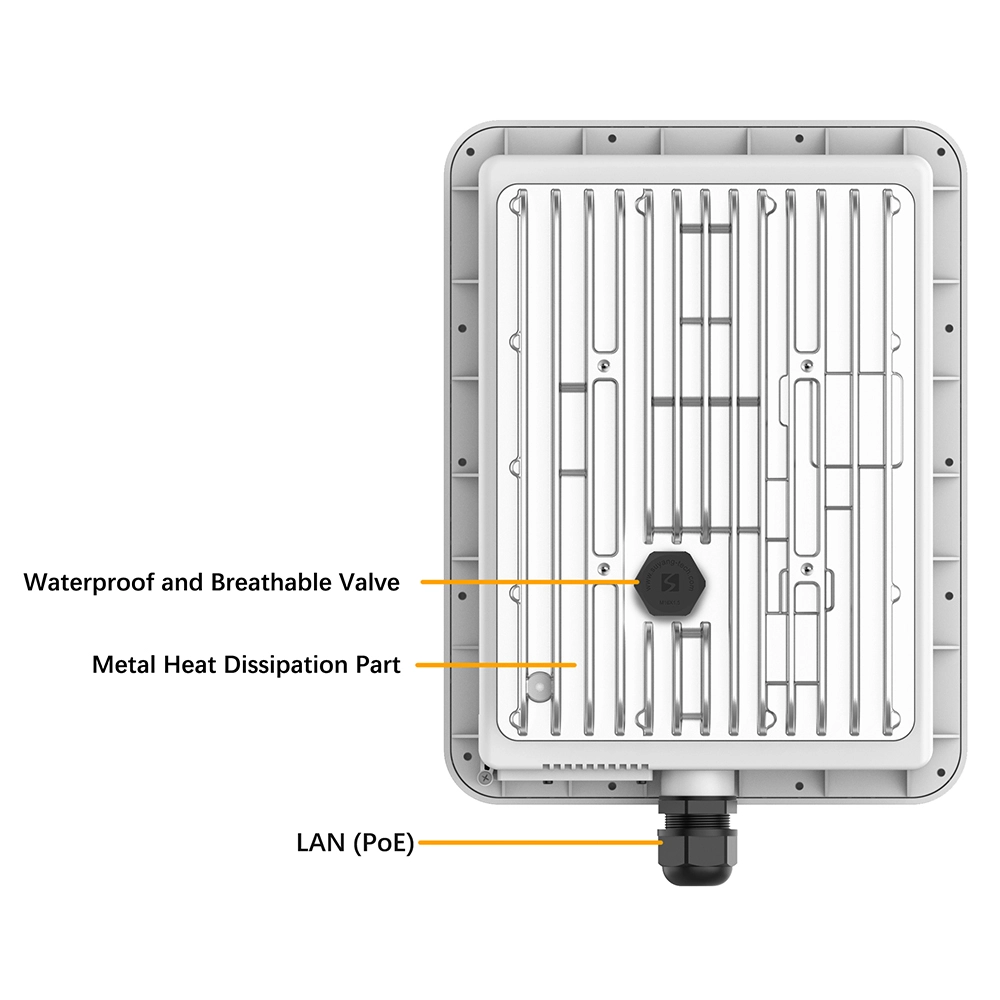
| Thermal Range | Passive Heat Dissipation (-10°C to +55°C) | Active Fan / Limited Range | Prevents thermal throttling inside uncooled industrial cabinets or outdoor enclosures. |
The Economics of R&D and Manufacturing Precision
Deploying a fleet of hundreds of routers across international borders requires absolute hardware predictability, which is why sourcing from an engineering-driven manufacturer with a 100% production-line testing protocol results in a first-pass yield 30% higher than the industry average.
When calculating the total cost of ownership (TCO) for a networking project, the purchase price of the router represents less than a quarter of the long-term cost. The real expenses accumulate through deployment delays, carrier incompatibility issues, and field maintenance logistics.
Partnering with a manufacturer that commands its own Surface Mount Technology (SMT) production lines and maintains a dedicated R&D team with over a decade of wireless terminal experience changes the entire equation. It allows commercial buyers to request deep hardware and software customization. Whether a project requires a specific frequency band lock to match a private LTE network in a South American mine, a custom-branded Web UI for an internet service provider (ISP) rollout, or integrated eSIM capabilities to prevent physical SIM card theft in public kiosks, factory-level engineering delivers exactly what standard retail brands cannot.
Ultimately, choosing the right wireless infrastructure is an investment in your business’s continuity. By deploying a converged cellular platform designed for the realities of the field, global enterprises protect their data, secure their connections, and ensure their commercial machinery never stops moving.
Global B2B Procurement & Technical FAQ
1. How does the router maintain connection stability if a local cell tower fails?
Our hybrid routers feature an automated Link Detection system tied to a hardware watchdog. The device continuously monitors link quality by pinging a designated target server. If the primary 5G tower drops or becomes congested, the firmware initiates an instant failover to backup LTE bands or an alternative SIM card slot within seconds, keeping active VPN sessions and data streams alive.
2. Can these routers be managed remotely without sending technicians to the field?
Yes. All of our enterprise-grade routers fully support the TR069 (CWMP) protocol. This allows your IT department to centrally monitor signal strength (RSRP/RSRQ), push batch firmware upgrades, modify WiFi parameters, and troubleshoot network faults across thousands of deployed units globally from a single dashboard.
3. Why is IPv4/IPv6 dual-stack support critical for commercial deployments?
As global telecommunications networks transition away from older IPv4 addresses, many modern 5G networks operate entirely on IPv6. Our dual-stack architecture ensures that your legacy corporate hardware (which may only support IPv4) can communicate seamlessly with modern IPv6 cloud servers without requiring expensive middleware or hardware upgrades.
4. What is the benefit of the “Band Locking” and “Cell Locking” features in the firmware?
In high-density commercial areas or industrial zones, routers often experience “tower hopping,” where the device switches between different base stations, causing packet loss. Our advanced Web UI allows network engineers to lock the router onto a specific frequency band or a precise base station cell ID (PCI), ensuring a predictable, rock-solid connection optimized for high-bandwidth tasks like video surveillance backhaul.
5. How do the thermal characteristics of these routers protect our field investments?
Standard consumer routers are prone to overheating and crashing when subjected to constant, high-speed 5G data transmission inside enclosed spaces. Our hardware is engineered with optimized PCB layouts and passive high-conductivity heat sinks, allowing stable, 24/7 continuous operation in environment temperatures ranging from -10°C to +55°C without the risk of component degradation.
6. Do you support hardware and software customization for large-scale tender projects?
Absolutely. Because we own our manufacturing facilities and drive our own R&D, we offer comprehensive customization services for B2B clients. This includes modifying physical interfaces (such as adding specific SMA external antenna configurations), pre-configuring custom APN profiles for private cellular networks, and flashing tailored firmware to meet regional carrier certifications.


What can we do for you?