
The Price Gap That Demands Explanation
B2B procurement managers often face a moment of budget shock when comparing industrial 4G/5G routers to consumer-grade alternatives. A high-end home router might cost $100–$300, while an industrial router with seemingly similar specifications can easily exceed $500–$1,000. The natural question arises: why not simply install a consumer router in a factory cabinet or outdoor surveillance enclosure?
The answer lies in the engineering decisions that are invisible on a spec sheet but become painfully apparent in the field. Industrial routers are not simply “more expensive versions” of consumer devices—they are fundamentally different products designed for fundamentally different operating conditions.
Consumer routers are designed for climate-controlled indoor environments with predictable power, minimal vibration, and consistent temperature. Industrial routers must survive temperature extremes, voltage fluctuations, electromagnetic interference, and continuous 24/7/365 operation, often in locations where a failure means sending a technician on an expensive truck roll.
This article examines the engineering differences between industrial and consumer routers across five critical dimensions, helping procurement professionals make informed decisions based on application requirements rather than price alone.
Section 1: Environmental Tolerance – From Climate-Controlled to Battle-Ready
The most fundamental distinction between industrial and consumer routers is environmental tolerance. Consumer routers are designed for office and home environments where temperature is regulated, humidity is controlled, and electromagnetic interference is minimal. Industrial routers must operate in conditions that would quickly destroy consumer-grade equipment.
Temperature Range
Consumer routers typically operate within a narrow 0°C to 40°C range. Industrial routers are engineered for extremes: many models support -40°C to 75°C operation. In a factory welding workshop where ambient temperatures reach 70°C, consumer routers crash from insufficient heat dissipation. Industrial routers, using metal housings and thermal-conductive materials, continue operating without interruption.
Protection Rating
Consumer devices offer minimal environmental protection (typically IP20). Industrial routers provide IP30, IP41, or even IP67 protection, resisting dust ingress and moisture. In outdoor monitoring applications, consumer routers experience interface corrosion within months. Industrial routers, with conformal coating on circuit boards and sealed enclosures, survive years of exposure.
Electromagnetic Compatibility (EMC)
Industrial environments generate significant electromagnetic interference from motors, drives, welding equipment, and power supplies. Consumer routers lack the shielding to handle this, experiencing high error rates or complete failure. Industrial routers undergo EMC Level III certification, with comprehensive ESD protection (up to 15KV) and surge immunity.
Section 2: Hardware Architecture – Components That Matter
The hardware differences between industrial and consumer routers are not about performance specifications but about survivability under stress.
Component Grade
Consumer routers use commercial-grade chips optimized for cost, with operating temperature limits of 0°C to 40°C and limited tolerance for voltage fluctuations. Industrial routers use automotive-grade or industrial-grade components with wide temperature tolerance (-40°C to 85°C), ECC error-correcting memory that automatically fixes bit errors during data transmission, and extended lifespans.
Power Supply Protection
Consumer routers assume clean, stable power. Industrial routers face voltage fluctuations, transients, and surges. Industrial power circuits include:
– Surge protection: Deflecting high-voltage spikes that would destroy consumer circuits
– Reverse polarity protection: Preventing damage from incorrectly connected power
– Wide input voltage range: Supporting 9–60V DC, accommodating industrial power variations
Enclosure Construction
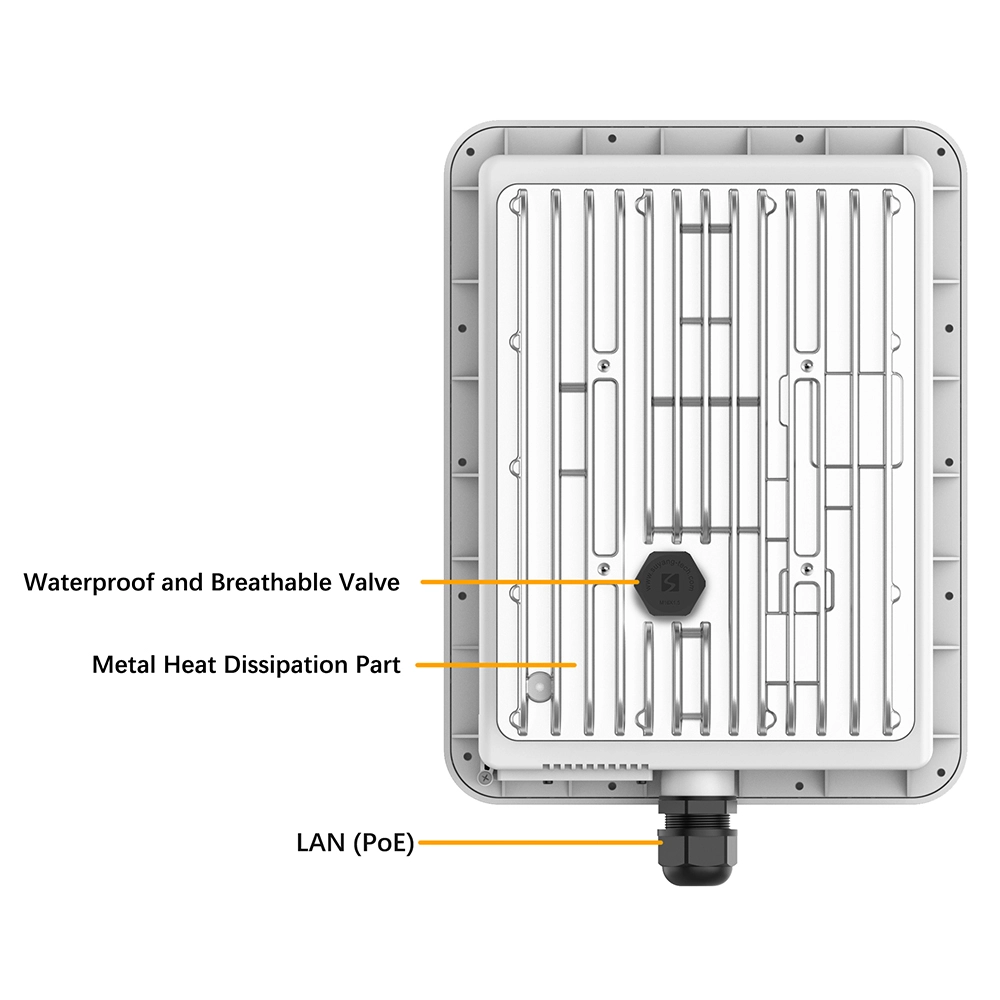
Consumer routers use plastic housings. Industrial routers use heavy-gauge metal enclosures—typically aluminum or steel—that provide both structural protection and passive heat dissipation. This eliminates the need for cooling fans, removing a common failure point in industrial environments.
Section 3: Interface Support – Connecting to Industrial Equipment
The interface requirements of industrial environments extend far beyond standard Ethernet. Industrial routers must communicate with legacy industrial equipment through specialized interfaces.
| Interface Type | Consumer Router | Industrial Router |
| Ethernet ports | 1 WAN + 1–4 LAN (100 Mbps – 1 Gbps) | 5+ ports, often all full-gigabit with redundancy support |
| Serial interfaces | None | RS232, RS485, RS422 for connecting PLCs, sensors, meters |
| Digital I/O | None | Digital inputs/outputs for monitoring and controlling external equipment |
| SIM slots | Usually single SIM | Dual SIM (or more) with automatic failover between carriers |
RS485, in particular, is critical for industrial applications. It supports multi-drop bus networks connecting dozens of sensors and meters over distances exceeding 1,200 meters, with strong interference resistance.
Section 4: Network Reliability – The Cost of Downtime
Perhaps the most compelling justification for industrial routers is their reliability engineering. The cost of a single network outage in an industrial setting can be measured in tens of thousands of dollars per hour. Industrial routers are designed to eliminate single points of failure.
Hardware Watchdog
Industrial routers incorporate dedicated hardware watchdog circuits that monitor the router’s operating system. If the system freezes or crashes, the watchdog automatically performs a hard reset within 60–90 seconds, restoring connectivity without human intervention. Consumer routers lack this capability, leaving field technicians to physically reset failed devices.
Multi-Network Redundancy
Industrial routers typically support:
– Dual SIM slots: Automatic failover between cellular carriers if one signal degrades
– WAN/LAN failover: Seamless switch from wired to cellular if the primary network fails
– Multi-link backup: Switching times under 3 seconds
Software Keep-Alive
Beyond hardware reliability, industrial routers implement sophisticated keep-alive mechanisms:
– PPP-layer keep-alive: Monitoring the actual cellular connection state
– ICMP ping monitoring: Testing reachability of designated endpoints
– Auto-reconnect logic: Re-establishing connections with exponential backoff
Consumer routers offer basic connectivity but lack the sophisticated health monitoring needed for unattended operation.
Section 5: Remote Management and Security
For distributed industrial deployments, remote management is not a convenience—it is a cost-saving necessity. The ability to diagnose, configure, and update devices without dispatching a technician drives the business case for industrial routers.
| Feature | Consumer Router | Industrial Router |
| Remote management | Limited (app-based or basic web) | TR069, SNMP, LwM2M, cloud platforms |
| VPN support | Basic (often limited to clients) | IPsec, OpenVPN, L2TP, PPTP, GRE with server capability |
| Firewall | Simple NAT | Stateful inspection, traffic filtering, DoS protection |
| Protocol support | TCP/IP only | Modbus, OPC UA, IEC104, DNP3, MQTT |
Industrial routers integrate with centralized management platforms that monitor thousands of devices, providing real-time alerts, bulk firmware updates, and remote troubleshooting. Organizations report improving operational efficiency by 60–80% through remote management capabilities.
Section 6: When to Choose Industrial vs. Consumer
Choose Consumer Router When:
– Deployment is indoors with climate control
– Power is stable and clean
– 24/7/365 uptime is not critical
– A technician can access the device easily if it fails
– Data usage is primarily download-oriented
– 5–10 concurrent users maximum
Choose Industrial Router When:
– Deployment is outdoors or in uncontrolled environments
– Temperature extremes are possible
– Electromagnetic interference exists from motors, drives, or power equipment
– Uptime is mission-critical (any outage costs > $500)
– Remote access to the site is difficult or expensive
– Interface requires RS232/RS485 for connecting to industrial equipment
– Multi-carrier redundancy is needed
– VPN tunnels to headquarters must be reliable
The True Cost of the Cheaper Option
The price premium on industrial routers is not an arbitrary markup. It reflects genuine engineering investments in wider-temperature components, ruggedized packaging, surge protection, hardware watchdog circuits, and industrial protocol support. These features are not “nice-to-haves”—they are requirements for reliable operation in industrial environments.
Procurement managers who choose consumer routers for industrial applications are not saving money. They are trading upfront cost for substantially higher total cost of ownership through increased failure rates, expensive truck-roll visits, and operational disruptions.
For applications requiring reliable 24/7 connectivity in challenging environments, the question is not whether the industrial router is worth the premium—it is whether the operation can afford the consequences of choosing the alternative.


What can we do for you?