
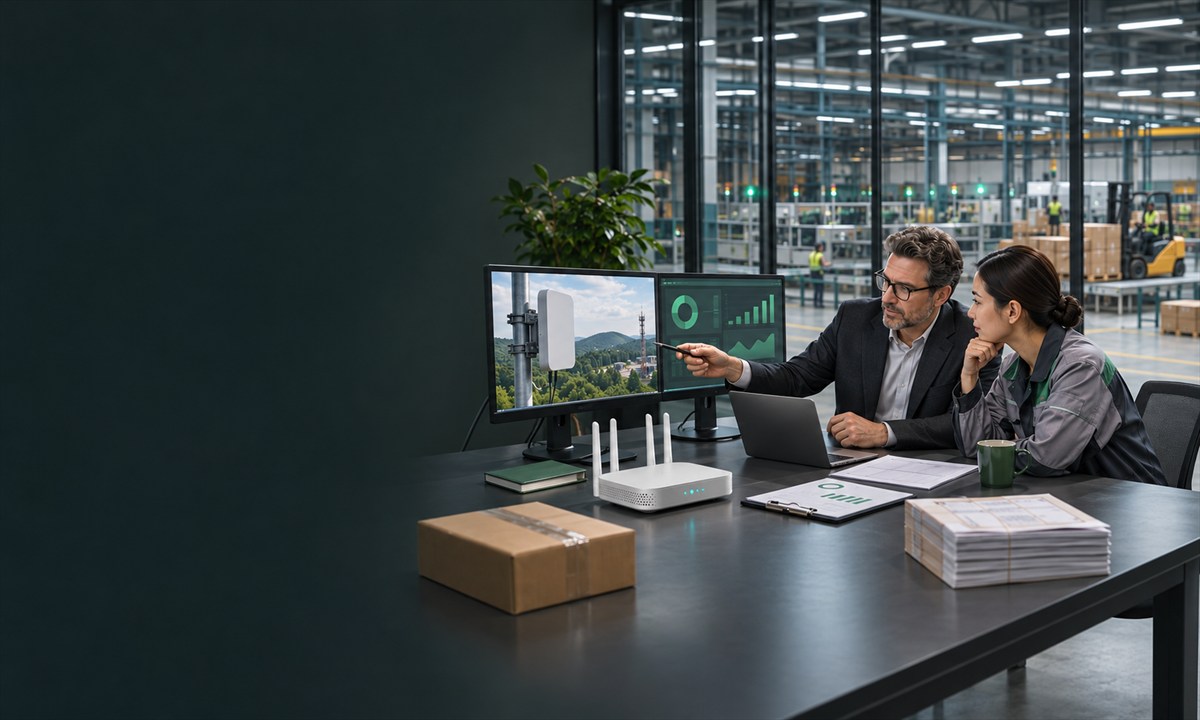
Secure 4G HD Voice Terminal for Saudi Arabia
The challenge
Saudi Telecom Company (STC), headquartered in Riyadh, required a fixed wireless voice solution for remote locations where conventional telephone lines were difficult to extend. The operator’s 2018 tender called for a Qualcomm-chipset platform capable of high-definition voice and secure network operation. The device also needed controls for PIN, SIM and network locking so it could be deployed under the operator’s service rules.
The application had to preserve the familiar behavior of a fixed telephone while using the mobile network as the access path. A standard wired telephone, PBX, alarm system, billing system or recording device should connect through RJ11 and make or receive calls across 4G LTE, 3G WCDMA or 2G GSM. For remote and mobile environments, the terminal also needed strong signal performance, clear status indicators and stable unattended operation.
Junhaoyue entered the tender with its A330 fixed wireless terminal based on the Quectel EC25-EU module. Passing the evaluation required more than demonstrating a successful call. The operator needed consistent VoLTE behavior, audio quality, network registration, caller ID, security settings, billing signals, power recovery and long-term stability. The product also had to be compact enough for residential, SOHO and business use while remaining easy to install.
The project therefore focused on a controlled operator configuration. Supported bands, SIM behavior, voice path, dialing tones, feed current, signal sensitivity and visible fault states all had to match the intended Saudi deployment. Security functions were especially important because the operator needed to prevent unauthorized SIM or network changes after the terminal entered service.
Our approach
The A330 used the industrial Quectel EC25-EU module and supported LTE FDD bands B1, B3, B7, B8, B20 and B28A; LTE TDD bands B38, B40 and B41; WCDMA bands B1 and B8; and GSM bands B3 and B8. The terminal provided one RJ11 interface, DC 12 V/1 A input, external antenna connection and USB access for online firmware upgrades. A digital SLIC design with noise reduction supported HD voice, while VoLTE enabled calls over the 4G network.
For fixed-telephone compatibility, the device supplied standard communication voltage and DTMF dialing, supported caller ID and generated a reverse-polarity billing signal. A built-in watchdog monitored operation and restarted the terminal automatically if a fault occurred. Volume adjustment and modem mode were included for different customer environments.
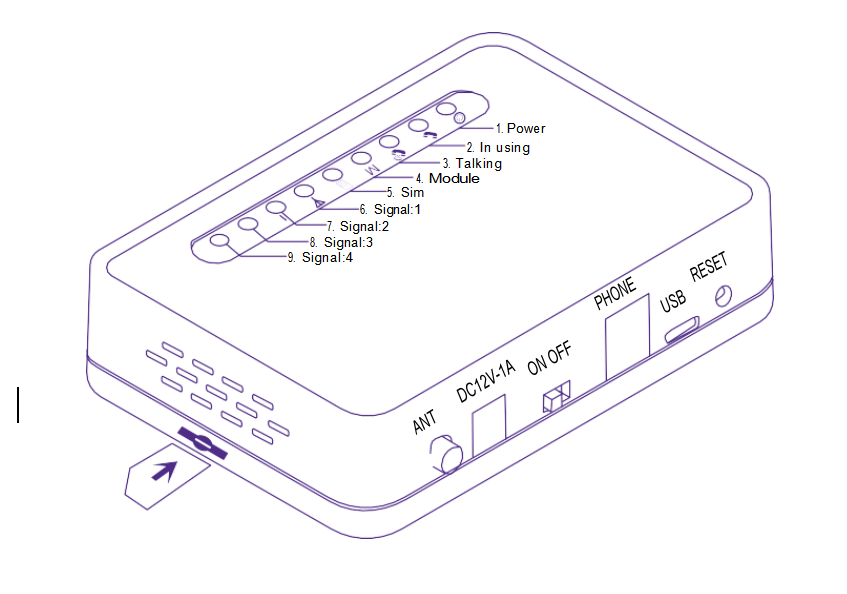
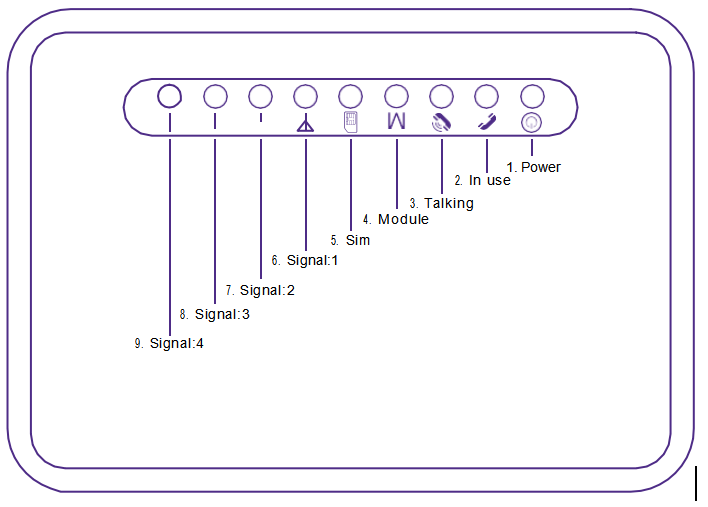
Security was implemented through automatic PIN, SIM and network locking. These controls allowed the operator to bind the terminal to the intended service configuration. The status system made faults visible without specialist tools: the power indicator remained on after startup, handset and call indicators showed off-hook and conversation status, and separate module and SIM indicators reported abnormal conditions. Four blue indicators displayed signal strength from weak to strong.
Installation followed a simple sequence. The wired telephone or other RJ11 device was connected first, the external antenna was installed away from televisions, computers and radios, the standard SIM card was inserted in the indicated orientation, and the terminal was powered on. Users could then make local or international calls through the available cellular network using the same habits as an ordinary fixed telephone.
Junhaoyue also documented operational limits and field precautions. The terminal was specified for 0 to 65 degrees Celsius and 10 to 90 percent humidity, with equipment power consumption of no more than 5 W. It should be installed in a ventilated, dry location with adequate signal and away from flammable environments or sensitive medical equipment. The compact unit measured 119 by 83 by 27 mm and had a net weight of about 130 g.
The operator evaluation continued for approximately one year. During this period, the terminal’s voice quality, band support, lock functions, indicators, interfaces and recovery behavior were tested against the tender requirements. Junhaoyue maintained the same controlled hardware and firmware baseline so results from different stages could be compared reliably.
The result
The A330 passed the STC evaluation and Junhaoyue received an order for 10,000 units. The award confirmed that the terminal met the operator’s requirements for secure SIM and network control, HD voice and dependable operation across cellular technologies. It also demonstrated that a compact fixed wireless terminal could replace a difficult or costly wired telephone connection without changing the end user’s basic calling experience.
Project outcomes
- VoLTE and digital SLIC technology provided clear HD voice for remote fixed-telephone applications.
- PIN, SIM and network locking protected the operator’s approved service configuration.
- LTE, WCDMA and GSM support provided fallback options across different coverage conditions.
- RJ11, caller ID, DTMF and reverse-polarity billing supported familiar telephone and business equipment.
- USB upgrade access and a hardware watchdog simplified long-term maintenance.
- A full set of status indicators helped installers identify signal, SIM or module issues quickly.
The terminal can be used in rural communities, mountain areas, tourist locations and other places where a fixed line is unavailable. It is also suited to moving environments such as ships, trains and coaches when wiring a conventional PSTN service is impractical. Connected devices may include ordinary telephones, PBX systems, alarm panels, billing equipment and recording boxes.
This project illustrates the value of matching a field problem to a controlled product platform. Junhaoyue did not substitute unrelated hardware during testing; the A330, EC25-EU module, firmware functions and installation method were evaluated as one system. That discipline helped the customer reach a clear approval decision and gave production a defined reference for the 10,000-unit order.