

Dual-SIM 4G Fixed Wireless Terminal with Relay Control for Australia
The challenge
NESS Corporation Pty Ltd has worked with Junhaoyue since July 2014, beginning with GSM fixed wireless terminals and later moving through 3G and 4G products. By 2024, the customer was ordering approximately 500 units per month of its regular 4G terminal model. On June 6, 2024, NESS submitted a new specification for a more advanced terminal that could combine cellular voice, SMS control, backup power and relay functions in one product.
The new model had to use the Quectel EC200D-AU module and support dual-SIM dual-standby single-pass operation. It needed to receive and reply to SMS, provide a SLIC circuit for connection to a telephone or FXO device, include a 6000 mAh battery with charging management and accept an external DC 12 V/1 A supply. The customer also required eight 12 V control outputs and relay circuits that could switch between high, low and pulse behavior.
Security rules were central to the application. A call from a whitelisted number had to activate an output, while a call from an unknown number had to be rejected. SMS commands from authorized numbers would control outputs 1 through 8; commands from other numbers would be ignored. This meant the design had to coordinate network registration, caller identification, whitelist logic, messaging, relay timing and local telephone operation.
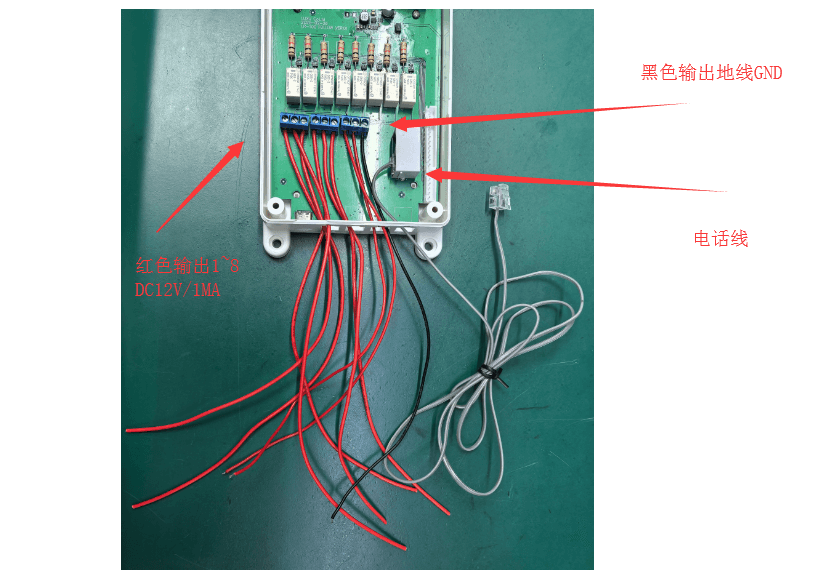
The project could not be finalized in a single sample cycle because the customer continued to refine the intended field workflow. Extra relays, input behavior, call-answer logic, enclosure construction and a second trigger input were added over time. Junhaoyue therefore needed a hardware and firmware architecture that could absorb controlled revisions without losing the stable voice and SMS functions already proven in the customer’s regular orders.
Our approach
Junhaoyue completed the first sample set after approximately two months of engineering work. The design integrated the EC200D-AU cellular module, dual SIM slots, SLIC circuitry, battery management, SMS handling and relay outputs. The customer then used the samples to refine the real operating logic. Version 2.0, revised July 5, 2025, added relay capacity and options. Version 3.0, revised August 15, 2025, allowed the dialler either to answer a call or operate in relay mode, and allowed Input 1 to call Phone Number 1.
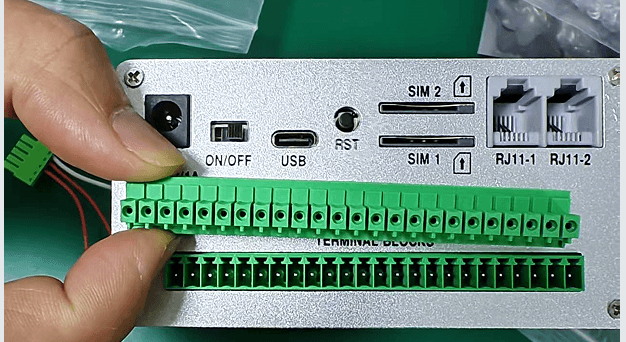
The customer also considered the original appearance insufficiently industrial. Junhaoyue responded by preparing a metal enclosure with wall-mounting points, external antenna connection, dual SIM access, two RJ11 ports, USB and a removable terminal block. The enclosure protected the electronics while making field wiring easier to inspect and service.
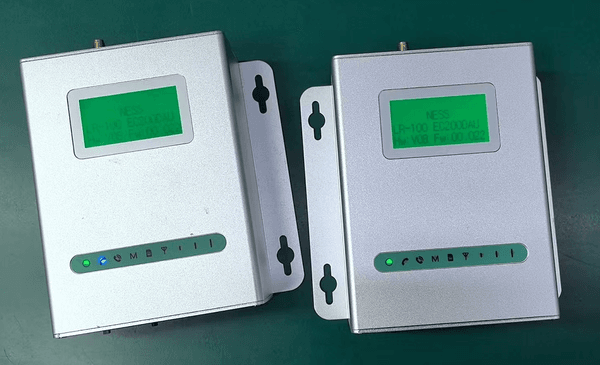
Version 4.0, revised October 14, 2025, added Input 2 and expanded the command set. Authorized users could program up to six phone numbers, clear individual numbers, select Answer or Relay control, choose Pulse or Toggle relay behavior and set the pulse time from 1 to 3600 seconds. Separate commands turned each relay on or off or produced a timed pulse. Other commands reset the dialler, reported signal strength, set the APN and returned stored options or the recent activity log.
Input 1 could be assigned either to Relay 1 or to a call to Phone Number 1. Input 2 could send custom SMS text and operate Relay 2 when enabled. The system could also return confirmation messages so installers knew that a command had been accepted. This command structure gave NESS a practical way to control remote equipment without a dedicated data connection or separate controller.
Junhaoyue kept the dual-SIM logic focused on continuity: one SIM operates while the second remains on standby and can switch when the active network becomes unavailable. The 6000 mAh battery was sized for more than 90 hours of operation, allowing the communications and control path to remain available during long power interruptions.
The result
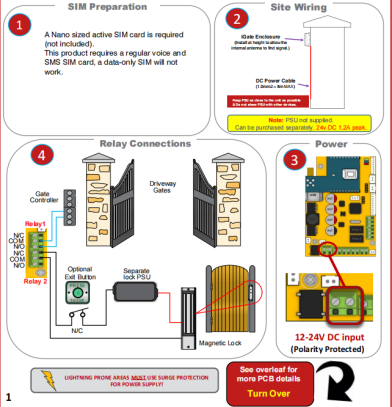
The resulting platform combines functions that are commonly spread across several devices. It can act as a conventional fixed wireless terminal for voice, receive authorized SMS commands, respond to whitelisted calls, switch multiple relays and report its own signal or configuration. The industrial enclosure, pluggable terminal block and clearly separated interfaces make it suitable for permanent remote installations.
Project outcomes
- Dual-SIM standby failover reduces dependence on a single mobile network.
- A 6000 mAh battery provides more than 90 hours of backup working time.
- Eight relay outputs support on, off, pulse and toggle control modes.
- Whitelist checks prevent unauthorized calls and messages from operating equipment.
- Inputs can trigger relay actions, telephone calls or custom SMS notifications.
- The metal enclosure and removable terminal block suit industrial field wiring.
The platform is particularly relevant to remote villas, gates and security systems, where a user may need to open or close equipment by call or SMS and still retain ordinary telephone access. The staged revisions also show why application development benefits from real sample testing. Each version translated field feedback into a named hardware or firmware change, giving both teams a clear approval path rather than allowing requirements to drift informally.
For Junhaoyue, the project extended a long-term customer relationship from standard FWT supply into a customized communications-and-control product. Existing cellular, voice and production experience provided a stable base, while the relay logic, battery capacity, enclosure and command set were developed around NESS’s specific installation workflow.